Author: admin

  • Boost Google Play downloads 3x with smarter visuals

    Boost Google Play downloads 3x with smarter visuals

    Your app could be losing hundreds of downloads every week, not because of bugs or missing features, but because your Play Store listing visuals are failing to convert. The Google Play average conversion rate benchmark sits at 27.3% in the US, yet well-optimized listings generate up to 3x more organic downloads than average ones. That gap is enormous, and the good news is that indie developers can close it without a big marketing budget. This article breaks down exactly why visuals are the most underrated growth lever on Google Play, what the data says, and what you can do about it starting today.

    Table of Contents

    Key Takeaways

    Point Details
    Visuals triple downloads Updating Play Store visuals can boost downloads up to 3x for indie apps.
    Testing maximizes results Ongoing A/B testing of your listing’s visuals keeps your conversions growing.
    Small teams can win Indie developers can outperform larger competitors with smart optimization.
    Tools simplify the process Using dedicated tools makes Play listing improvements fast and accessible.

    Understanding Google Play optimization: Not just keywords

    Most developers hear “app store optimization” and immediately think about keywords, titles, and descriptions. That instinct is understandable. Keywords are measurable, familiar, and feel like something you can control. But they only get users to your listing. What converts those visitors into downloads is something else entirely.

    Visual assets, specifically your screenshots, feature graphic, and app icon, are the first things a user processes when they land on your Play listing. Before they read a single word of your description, they have already formed an opinion based on what they see. That opinion drives the download decision more than any keyword ever will.

    Here is what many developers miss:

    • Screenshots are the most viewed element on any app listing
    • Icons create the first impression in search results, before the listing is even opened
    • Feature graphics set the emotional tone for your entire brand
    • Consistency across all visual assets builds trust faster than five-star reviews

    “The biggest mistake indie developers make is treating visuals as an afterthought. They spend weeks polishing features and hours on their keyword strategy, but upload screenshots that look like they were taken on a lunch break.”

    The data backs this up. Well-optimized listings generate up to 3x more organic downloads, and the primary driver of that lift is visual quality. If you are serious about enhancing app visibility, the fastest path forward starts with your screenshots, not your metadata.

    Evidence: How visuals drive conversion rates

    Knowing visuals matter is one thing. Seeing the numbers is another. Let’s look at what the research actually shows.

    A/B testing data from Google Play Store listing experiments consistently shows that visual changes produce the largest and fastest conversion lifts. Text changes, like tweaking your short description, tend to produce modest gains. Swapping out screenshots or redesigning your feature graphic can move the needle dramatically.

    Visual element Avg. conversion lift Time to see results
    Screenshots (redesigned) Up to 30% 7 to 14 days
    Feature graphic update 10 to 20% 7 to 14 days
    Icon refresh 5 to 15% 7 to 21 days
    Short description tweak 2 to 8% 14 to 28 days

    The pattern is clear. Visual changes move faster and hit harder than text changes. Up to 3x more organic downloads is not a theoretical ceiling. It is a real outcome that teams have measured through controlled experiments.

    Stat to remember: A single screenshot redesign test can produce a 30% conversion lift in under two weeks. For an app getting 1,000 store visits per month, that is 300 extra downloads with zero ad spend.
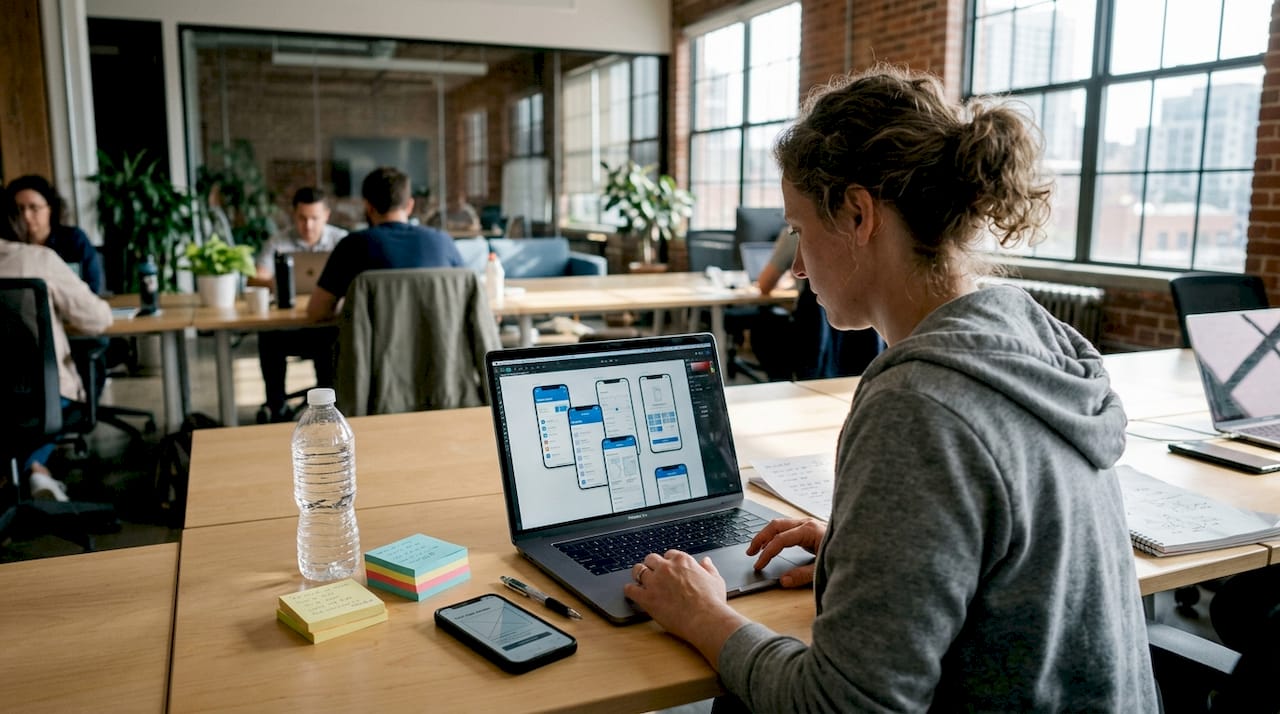
    Woman updates app visuals on laptop at table

    Pro Tip: Lead with your most compelling screenshot. Users on mobile rarely scroll past the first two. Make sure your first screenshot communicates the core value of your app in under three seconds.

    For indie teams, screenshot optimization is the highest-ROI activity you can do this week. You do not need a designer. You need a clear message and the right tool to present it visually.

    Visual optimization in action: What actually works

    Data is great, but what should you actually change tomorrow? Here is a practical walkthrough of what to prioritize and what to skip.

    1. Audit your current screenshots. Open your Play listing on a phone, not a desktop. Look at it the way a real user would. Does the first screenshot immediately communicate what your app does and why it matters? If you have to think about it, users will not bother.
    2. Add text overlays to your screenshots. Plain app UI screenshots without context perform significantly worse than screenshots with short, benefit-focused captions. Think “Track habits in 30 seconds” not “Home screen.”
    3. Use device mockups. Screenshots placed inside clean 3D device frames look more professional and trustworthy. They also help users visualize the app in real use.
    4. Prioritize the first two screenshots. On most devices, only the first one or two screenshots are visible without scrolling. These are your highest-value real estate.
    5. Match your visual style to your brand. Consistent colors, fonts, and tone across all screenshots signal that your app is polished and maintained.

    Well-optimized visuals can multiply organic downloads for Google Play apps, and the changes above are the ones that produce the fastest results.
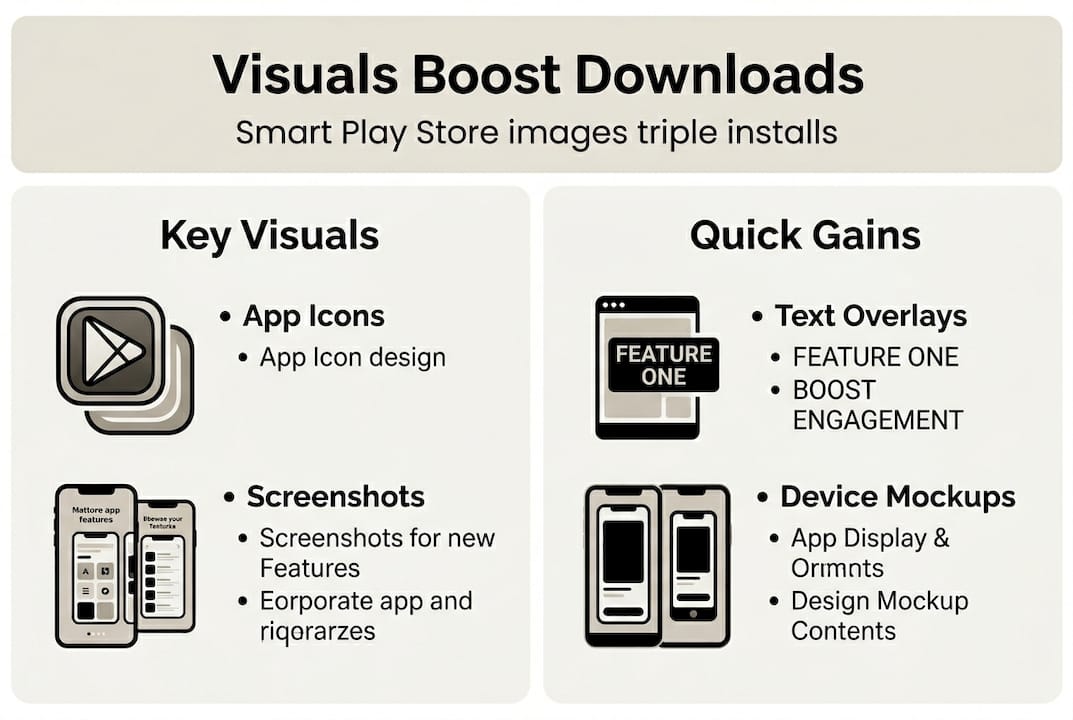
    Infographic on Google Play visual optimization tips

    Pro Tip: Do not try to show every feature. Pick the three most compelling benefits your app delivers and build one screenshot around each. Clarity beats completeness every time.

    For quick wins, start with text overlays and device mockups. These two changes alone can dramatically improve how professional your listing looks. For longer-term gains, focus on increasing app engagement through consistent visual storytelling across your entire listing.

    Sustaining results: Testing and iterating your Play listing

    After your first optimization, staying ahead means continuous learning. A single round of visual improvements is a great start, but the developers who consistently grow their downloads treat their Play listing like a living product, not a one-time setup.

    Google Play’s built-in listing experiments tool lets you run A/B tests on your screenshots, icons, and descriptions. You split your traffic, measure conversion rates, and let data pick the winner. It is free, built into the Play Console, and most developers never use it.

    Testing approach Best for Effort level
    Google Play listing experiments Screenshots, icons, descriptions Low
    External landing page tests Pre-launch validation Medium
    Manual version comparison Small teams without traffic Low
    Third-party ASO tools Advanced segmentation High

    Continuous listing experiments on Google Play can drive repeated download lifts over time. The key is to test one variable at a time so you know exactly what caused the change.

    Here are the top habits for sustained visual performance:

    • Run one experiment at a time. Testing multiple elements simultaneously makes it impossible to know what worked.
    • Wait for statistical significance. Do not call a winner after two days. Let the test run for at least one to two weeks.
    • Document every test. Keep a simple log of what you tested, what won, and by how much. Patterns emerge over time.
    • Refresh visuals seasonally. Updating screenshots around major app updates or seasonal events keeps your listing feeling current.
    • Use visual mockup strategies to speed up iteration. The faster you can produce new screenshot variants, the more tests you can run.

    The developers who win long-term on Google Play are not the ones who optimize once. They are the ones who build a habit of testing.

    Why many developers underestimate visual optimization

    Let’s zoom out and rethink conventional wisdom. Most indie developers are builders at heart. They measure progress in features shipped, bugs fixed, and code quality improved. That mindset is valuable, but it creates a blind spot.

    Users do not see your code. They see your screenshots. And in the three seconds they spend deciding whether to download your app, visuals do more persuasive work than any feature list ever could.

    The uncomfortable truth is that a mediocre app with great visuals will often out-convert a great app with mediocre visuals. That is not a cynical take. It is just how human perception works. Trust is built visually before it is built functionally.

    For resource-constrained indie teams, visual optimization is also the highest-ROI investment available. You do not need to hire a designer or run paid campaigns. A few hours spent on screenshots can produce gains that months of feature development cannot match in terms of download growth.

    The proven methods for indie devs that actually move the needle are not always the most technically impressive ones. Sometimes the biggest growth lever is the one that looks the simplest.

    Next steps: Instantly enhance your Play visuals

    Ready to put these strategies into practice? The gap between knowing what to do and actually doing it comes down to having the right tools and a clear starting point.
    https://appscreenkit.com

    AppScreenKit is built specifically for indie developers and small teams who want professional Play Store visuals without the design overhead. You can upload your app UI, drop it into a 3D device mockup, add benefit-focused text overlays, and export pixel-perfect screenshots for every required device size in minutes. No Figma skills needed. No back-and-forth with a designer. The screenshot generator handles the technical requirements automatically, so you can focus on messaging and conversion. If you are ready to test a new visual direction for your listing, instant visual upgrades are just a few clicks away.

    Frequently asked questions

    What does Google Play optimization include?

    It covers keywords, descriptions, icons, screenshots, ratings, and ongoing A/B testing across all listing elements for best results.

    How much can optimizing visuals improve downloads?

    Well-optimized listings generate up to 3x more organic downloads based on real A/B testing data from Google Play experiments.

    What tools help create effective app visuals?

    Tools like AppScreenKit make building compelling Play Store screenshots and mockups quick and easy, even for solo indie developers with no design background.

    Why not just rely on user reviews for growth?

    While reviews build long-term credibility, visuals impact conversion far before reviews are read, making them the primary driver of first-time download decisions.
  • App visual marketing: strategies that boost downloads

    App visual marketing: strategies that boost downloads

    Standing out in a crowded app store is one of the hardest challenges indie developers face. Your app could be genuinely excellent, but if the visuals on your listing page are weak, most users will scroll right past it. Screenshot optimization increases conversion rates by an average of 18%, and in some cases up to 60%. That kind of lift is not something you get from a minor tweak. This article breaks down every major visual marketing strategy, from icon design to localization, so you can prioritize the moves that deliver the biggest return.

    Table of Contents

    Key Takeaways

    Point Details
    Icon optimization matters Well-designed icons can raise click rates and app rankings significantly.
    Screenshot strategy delivers Compelling screenshots directly boost conversion rates and downloads.
    Localization opens markets Localizing visuals and UI greatly increases conversions in new regions.
    Free tools empower indies Canva, Figma, and AI tools make visual upgrades affordable and efficient.
    Comparison guides priorities Reviewing strategies side-by-side helps target biggest-impact improvements first.

    Start with standout app icons

    Your app icon is the first thing a user sees in search results. Before they read your title, before they look at your screenshots, they see that tiny square. It sets the tone for everything else.

    The most effective icons follow a clear formula. They use a single recognizable visual element, not a collage of features. They rely on high contrast colors that pop against both light and dark backgrounds. And they look distinctly different from competing apps in the same category. According to research on icon design impact, well-optimized icons can increase click-through rates by 8 to 12%, compared to the average 2 to 5%, and improve search rankings by 5 to 15 positions. That is a meaningful edge in a competitive category.

    Here is what separates high-performing icons from forgettable ones:

    • Single focal point: One strong visual element beats a busy design every time.
    • High contrast palette: Bold colors outperform muted or pastel tones in search results.
    • Category differentiation: If every competitor uses blue, try a warm color. Stand out visually.
    • Scalability: Your icon must look sharp at 29×29 pixels and at 1024×1024 pixels.

    Stat callout: Icons optimized for contrast and simplicity improve CTR by 8-12%, directly feeding into better organic rankings.

    Pro Tip: Download the top 10 apps in your category and line up their icons side by side. Look for the dominant color, shape, and style. Then design yours to break the pattern intentionally.

    Screenshot optimization for higher conversions

    With your icon optimized, next comes the most visual part of your listing: your screenshots. This is where users decide whether your app is worth a download. Most developers treat screenshots as an afterthought. That is a costly mistake.

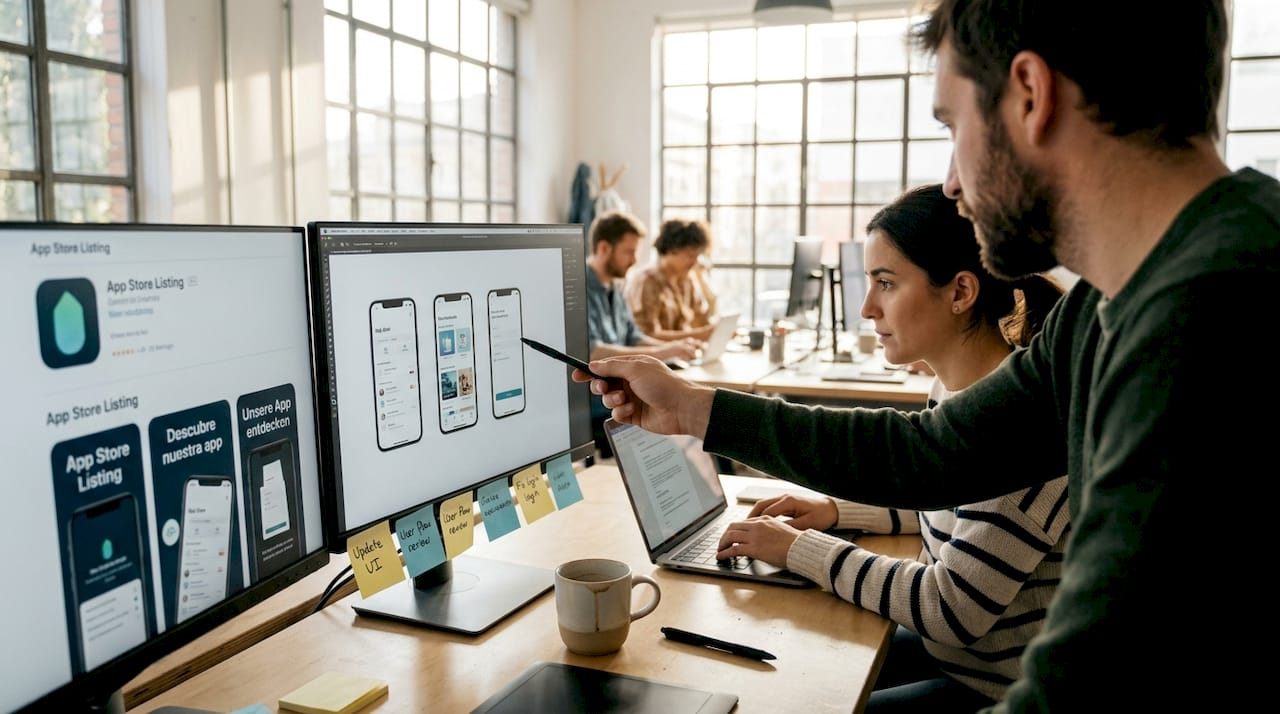
    Team reviewing app screenshots at desk

    The order of your screenshots matters enormously. Your first screenshot should showcase your single most compelling feature or benefit, not a generic welcome screen. Users make decisions in seconds, and screenshot best practices confirm that leading with your strongest value proposition is the highest-impact change you can make.

    Here is a practical process for building a high-converting screenshot set:

    1. Lead with your core benefit. Frame screenshot one around the problem your app solves.
    2. Use short, bold text overlays. Keep captions under six words. Make the benefit obvious at a glance.
    3. Show real UI. Authentic interface screenshots outperform stock imagery or illustrated mockups.
    4. Use device mockups. Placing your UI inside a clean 3D device frame adds professionalism and context.
    5. Maintain visual consistency. Use the same color palette, font, and tone across all screenshots.

    “The apps that convert best treat their screenshot set like a mini ad campaign, not a feature list.”

    Pro Tip: Tools like the AppScreenKit screenshot generator let you drop your UI into professional 3D device mockups and export all required sizes in one click. For indie developers without a design team, that kind of speed is a genuine competitive advantage.

    Strategic localization: Unlock new markets

    Once your screenshots are optimized, next-level app growth comes from targeting new audiences with strategic localization. Most indie developers skip this step entirely, which means the opportunity is wide open.

    Localization is not just translating your app description. It means adapting your screenshots, text overlays, and metadata for specific regions and languages. The results are significant. Localization boosts CVR by 15 to 40% on average, and full UI localization in non-English markets can push that lift to 30 to 50%. Meanwhile, top apps localize for 75 to 96% of their target markets and use Custom Product Pages (CPPs) to achieve an additional 25 to 45% conversion lift.

    For indie developers, you do not need to localize everywhere at once. Prioritize strategically:

    • Japanese and Korean markets respond strongly to polished, detail-rich visuals.
    • German and French markets expect localized text in screenshots, not just the app description.
    • Spanish-speaking markets are large and often underserved by indie apps.
    • Brazilian Portuguese is distinct from European Portuguese and worth treating separately.

    The table below shows how localization depth affects conversion rates by region:

    Region Basic localization (text only) Full visual localization Full UI localization
    Japan +15% CVR +30% CVR +45% CVR
    Germany +12% CVR +25% CVR +38% CVR
    Brazil +18% CVR +32% CVR +50% CVR
    France +10% CVR +22% CVR +35% CVR

    Even basic localization of your screenshot text overlays can unlock meaningful growth in markets where your app currently has zero presence.

    Leverage free tools and AI for rapid iterations

    Localization can feel daunting, but free tools and rapid iteration can make even complex visual changes manageable and consistently rewarding. The good news is that you do not need a big budget to test and improve your visuals continuously.

    Free tools like Canva and Figma, combined with AI tools like ChatGPT for generating copy ideas, give indie developers a fast prototyping workflow at zero cost. The key is not to perfect your visuals once and move on. The key is to treat your app listing as a living asset that you improve every week.

    Here is a practical iteration workflow for small teams:

    • Week 1: Audit your current screenshots against the top three competitors in your category.
    • Week 2: Redesign your first two screenshots using the benefit-first framework.
    • Week 3: Run an A/B test using your app store’s built-in testing tools.
    • Week 4: Track your top 10 keywords weekly and note any ranking shifts.
    • Ongoing: Localize one new market per month, starting with the highest-traffic region.

    Pro Tip: Long-tail keywords (three to five word phrases) are far less competitive than broad terms and often convert better because they attract users with specific intent. Pair keyword tracking with visual updates using the AppScreenKit visual iteration tools to see which changes drive the most measurable lift.

    The compounding effect of consistent iteration beats a single big redesign every time. Small weekly improvements add up to significant ranking and conversion gains over a quarter.

    Visual strategy comparison: Which moves boost your metrics fastest?

    With individual strategies explored, let’s compare their impact side by side so you can prioritize your next move. Not every tactic delivers the same return for the same effort, and as an indie developer, your time is your most limited resource.

    It is worth noting that 65 to 70% of downloads come from organic search, and average conversion rates sit at 28 to 33% on the App Store and 23 to 28% on Google Play. That means visual and ASO improvements directly affect the majority of your potential downloads.

    Strategy Conversion impact Effort level Cost
    Icon optimization CTR +8 to 12% Low Free to low
    Screenshot redesign CVR +18 to 60% Medium Free to low
    Basic localization CVR +15 to 40% Medium Free to low
    Full UI localization CVR +30 to 50% High Low to medium
    Iterative A/B testing Compounding gains Low (ongoing) Free

    Based on this breakdown, here is how to sequence your efforts:

    • Start with screenshots. Highest impact, medium effort, and directly testable.
    • Fix your icon next. Low effort, measurable CTR gains, and a one-time investment.
    • Add basic localization. Pick one high-value market and localize your screenshot text.
    • Build an iteration habit. Weekly tracking and monthly updates compound over time.

    The developers who grow fastest are not the ones who launch perfectly. They are the ones who improve consistently.

    Bring your app visuals to life: Next steps with AppScreenKit

    Now that you know which visual strategies matter most, here is how to take action with a tool built for indie dev agility. Creating professional screenshots used to mean hiring a designer or spending hours in Figma. That is no longer the case.

    https://appscreenkit.com

    AppScreenKit is built specifically for indie developers and small teams who need polished, store-ready visuals without the overhead. You can upload your app UI, place it inside true 3D device mockups that rotate in real space, add branded text and gradient backgrounds, and export pixel-perfect screenshots for every required device size in a single click. No design skills needed. No manual resizing. No rejection headaches. The free starter plan lets you get started immediately, so you can implement everything covered in this article today, not next sprint.

    Frequently asked questions

    How much can app icons really affect downloads?

    Optimized icons can boost click-through rates by 8 to 12%, which leads to improved search rankings and more organic downloads over time.

    Are localized screenshots worth it for indie apps?

    Yes. Localizing screenshots can boost conversion rates by 15 to 40%, making it especially valuable for non-English markets where competition from indie apps is lower.

    What free tools should small teams use for app visuals?

    Canva and Figma are strong starting points for visual design, and AI tools like ChatGPT help generate screenshot copy ideas quickly and at no cost.

    Is screenshot optimization more effective than paid ads?

    For indie developers, ASO and screenshot optimization typically deliver better long-term ROI than paid user acquisition, especially early on, because the gains compound with every iteration.

    Article generated by BabyLoveGrowth

  • App image launch workflow: boost installs by 20-40%

    App image launch workflow: boost installs by 20-40%

    Your app could be brilliant, but if the screenshots look rough or fail spec checks, users scroll past and stores reject your build. Optimized screenshots lift conversion rates by 20-40%, yet most indie teams treat images as an afterthought. This guide walks you through a proven, efficient workflow, from raw UI captures to a polished, compliant screenshot set ready for both the App Store and Google Play. No design degree required, just the right process and tools.

    Table of Contents

    Key Takeaways

    Point Details
    Lead with your value Your first screenshot and caption are critical for conversion—make them count.
    Match platform specs App images must follow the exact size and style rules for each store or risk rejection.
    Test and localize A/B testing variants and localizing images can significantly boost downloads.
    Avoid easy mistakes Incorrect sizes, alpha channels, or unstyled images kill conversion and may block launch.
    Use efficient tools Template-based generators save hours and help indie teams stand out fast.

    What you need before you start

    With the stakes established, let’s walk through what you’ll need to prepare polished, compliant screenshots from the start. Skipping this prep phase is the single biggest reason teams waste hours on rework.

    Essential assets checklist:

    • Raw UI screenshots at the highest resolution your device supports
    • Brand colors, fonts, and logo files
    • Background images or gradient values
    • Benefit-driven caption copy (written before you open any design tool)
    • Device frame assets or access to a template tool

    File format and size matter more than most developers expect. App Store screenshot sizes must match exact specs or face rejection, for example 1290x2796px for iPhone 6.7-inch, PNG or JPEG only, and absolutely no alpha channel. Meanwhile, Google Play requires a feature graphic at 1024x500px, with phone and tablet screenshots submitted separately.

    Here is a quick reference for the most common sizes:

    Platform Device Required size Format
    App Store iPhone 6.7-inch 1290x2796px PNG/JPEG
    App Store iPhone 6.5-inch 1242x2688px PNG/JPEG
    App Store iPad Pro 12.9-inch 2048x2732px PNG/JPEG
    Google Play Phone 1080x1920px (min) PNG/JPEG
    Google Play Feature graphic 1024x500px PNG/JPEG

    For template tools, options like AppScreenKit, AppLaunchpad, and ScreenshotWhale all let you work from pre-built layouts and export to exact specs. Using an App Store screenshot generator cuts setup time dramatically compared to building layouts from scratch in Figma.

    Pro Tip: Always start with the highest resolution image you need and export down. Upscaling a small image introduces blur that reviewers and users will both notice.

    Mismatched dimensions and alpha channels are the top two rejection triggers. Catch them before upload, not after.

    Step-by-step: Creating app images that drive downloads

    Now that you have all assets lined up, here is the workflow to craft images that boost installs and avoid the most common pitfalls.

    1. Capture raw screenshots directly from a real device or high-fidelity simulator at the target resolution.
    2. Pick a template that matches your app’s tone. Minimal and clean works for productivity; bold and colorful works for games.
    3. Write benefit-driven captions before placing them. “Save 2 hours weekly” beats “Task management made easy” every time.
    4. Apply consistent branding across all images: same font, same color palette, same device frame style.
    5. Export at exact specs for every device size you need to cover. One click bulk export saves significant time.
    6. Sequence for impact. Lead with your strongest value prop, then build a visual story across images 2 through 8.

    The first screenshot is seen by 100% of users, and A/B testing it can produce compounding gains over time. That first frame is your headline. Treat it like one.

    Screenshots with clear benefit captions, consistent style, and real UI consistently outperform stylized but vague alternatives. Users want to see what the app actually does, fast.

    “Never use unstyled screenshots. Raw captures leak 20-30% of potential conversions before a user even reads your description.”

    Platform tone differs too. App Store users respond to emotional, story-driven visuals with short captions and darker, premium aesthetics. Google Play users tend to favor utility-focused images with slightly longer captions and lighter backgrounds. Following the app image workflow conventions for each store is worth the extra effort. You can design and export polished screenshots for both platforms from a single session using the right tool.

    Also, use 5-8 images that tell a user story, match exact specs, export as PNG or JPEG, and order them for maximum impact.

    Pro Tip: Before uploading, preview your final images on an actual device screen. Text that looks readable on a desktop monitor can become tiny and unreadable on a 5-inch phone display.

    Platform-specific tips: Apple App Store vs Google Play

    With the general workflow clear, here is how to adjust for platform-specific requirements and leverage each store’s stylistic trends.

    Factor App Store Google Play
    Key phone size 1290x2796px (6.7-inch) 1080x1920px minimum
    Feature graphic Not required 1024x500px required
    Alpha channel Not allowed Not allowed
    Caption style Short, emotional Longer, utility-focused
    Tone Premium, story-driven Practical, benefit-led
    Tablet submission iPad required separately Tablet optional but recommended

    Apple requires exact export to 1290x2796px for iPhone 6.7, no alpha channel; Google requires a 1024x500px feature graphic with phone and tablet handled separately. Getting these wrong is the fastest path to rejection.

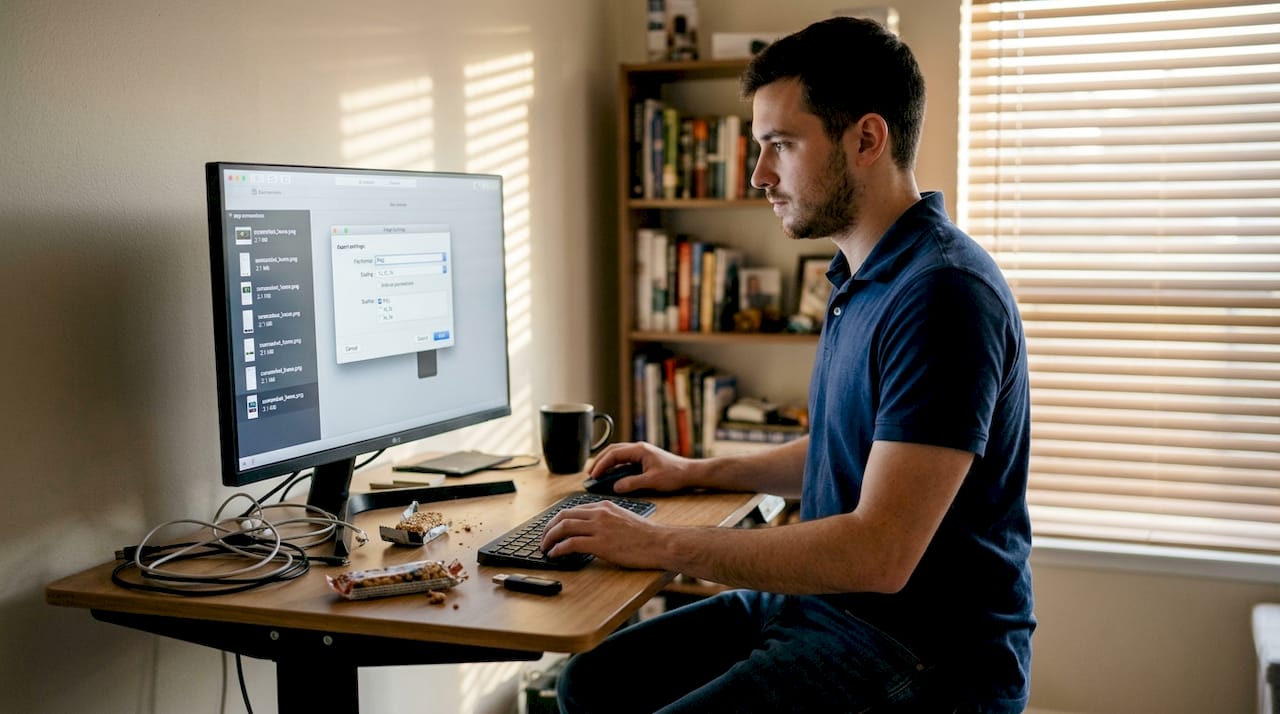
    Developer exporting images on desktop monitor

    Style differences matter just as much as technical specs. The App Store favors emotional story-driven images while Google Play skews more utilitarian. Test framed versus frameless device mockups in your category to see what converts better.

    Key design differences to keep in mind:

    • App Store: darker backgrounds, premium feel, minimal text per image
    • Google Play: lighter palettes, more descriptive captions, feature-forward framing
    • Both: avoid misleading claims, unlocalized UI, or screenshots that don’t reflect the actual app
    • Include a Dark Mode screenshot if your app supports it
    • Localizing captions for key markets can yield 15-40% higher conversion rates

    Check screenshot guidelines detail for iPad and tablet-specific requirements, which differ from phone specs and are easy to overlook. Use AppScreenKit to generate platform-optimized screenshots for both stores without switching tools.

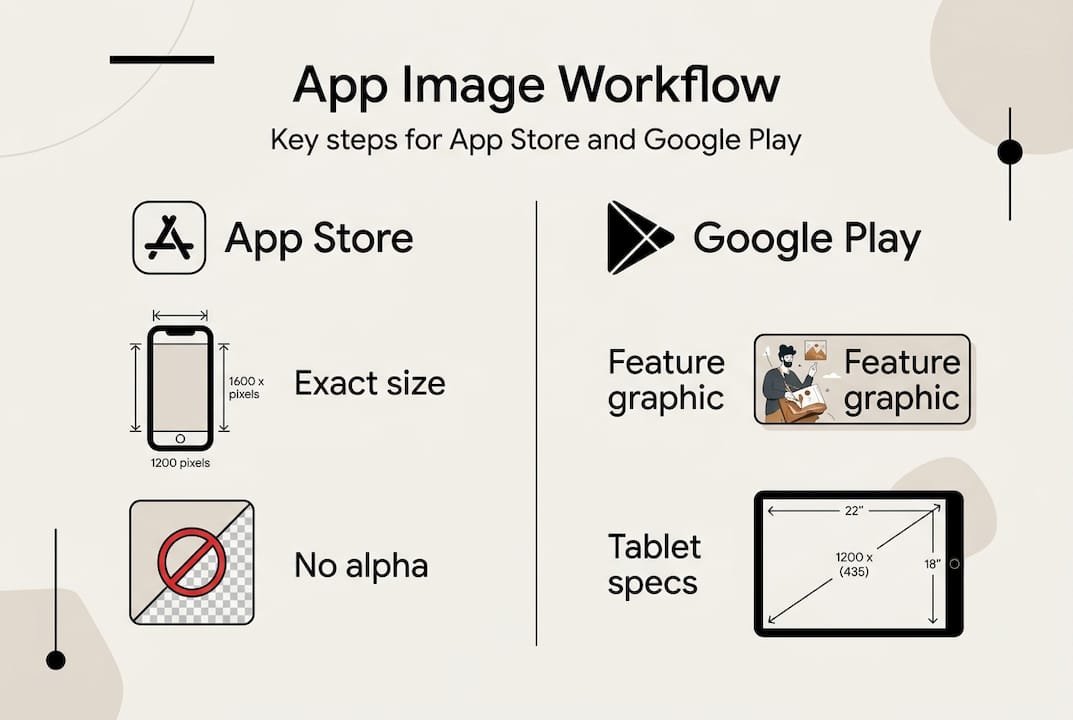
    Infographic comparing App Store and Google Play image workflow

    Testing, localization, and post-launch optimization

    After uploading your images, don’t stop. Here is how to continually improve performance and reach more users with data-driven tweaks and local upgrades.

    CVR lifts 20-40% with optimized screenshots; A/B testing captions and backgrounds yields 10-20% gains; localizing text drives 15-40% higher CVR. These are not marginal improvements. They compound.

    Post-launch optimization process:

    1. Preview all uploaded images in the store listing before going live.
    2. Spot-check for any rejection flags: wrong dimensions, alpha channels, misleading text.
    3. Set a baseline conversion rate from your analytics dashboard.
    4. Run an A/B test using Apple’s Product Page Optimization (PPO) or Google’s Store Listing Experiments.
    5. Change only one variable per test: caption, background color, or image order.
    6. Run each test for 1-4 weeks to reach statistical confidence.
    7. Apply the winner, then test the next variable.

    Apple PPO and Google Listing Experiments support up to 3 visual variants and deliver 90% statistically confident results. Top apps update their screenshots 2-4 times per year based on test results and seasonal trends.

    Pro Tip: Use AppScreenKit to A/B test screenshot variants quickly. Pre-built templates mean you can produce a new variant in minutes, not hours, keeping your test cadence tight.

    For localization, AI-powered screenshot localization tools can automate caption translation and text placement across multiple languages. Prioritize markets where your app already has organic traction before expanding further.

    Common mistakes and troubleshooting

    Mistakes cost time and downloads. Here are the most common pitfalls indie teams hit, and how you can sidestep them before shipping.

    Most common app image mistakes:

    • Wrong file dimensions for the target device size
    • PNG files saved with an alpha (transparency) channel
    • Inconsistent visual style across the screenshot set
    • Text too small to read on a real device screen
    • Captions that make claims not visible in the actual UI
    • Raw, unstyled screenshots with no context or framing
    • Unlocalized UI text in screenshots submitted to non-English markets

    Rejection triggers include wrong sizes, alpha channels, misleading claims, unlocalized UI, and raw unstyled screenshots. Every item on that list is preventable with a quick pre-upload checklist.

    Before you upload, run through these quick checks: confirm pixel dimensions match the spec table, open the file in Preview or Photoshop and verify no alpha channel exists, read every caption aloud and confirm the UI in the screenshot actually shows what the caption claims.

    “Consistency and honesty in images builds trust and avoids rejections. If your caption says it, your screenshot must show it.”

    Save your template settings and export configurations after each project. When your next update rolls around, you can avoid common screenshot issues by loading the saved setup and swapping in new UI captures rather than rebuilding from zero.

    Launch with stunning app images, get started fast

    Ready to apply everything above? The fastest way to create polished, on-brand screenshots is with the right tool designed for indie teams.

    AppScreenKit was built specifically for developers who need professional results without a design team. Upload your raw UI captures, choose from pre-built templates, add benefit-driven captions, and export pixel-perfect images for every required device size in one session.

    https://appscreenkit.com

    The platform handles bulk resizing automatically, so you never manually calculate dimensions or worry about alpha channels slipping through. Whether you’re preparing for your first launch or refreshing images after an A/B test, the App Store Screenshot Generator gives you a repeatable, fast workflow that scales with your app. Start with the free plan and see how quickly polished screenshots come together.

    Frequently asked questions

    How many app screenshots should I prepare for launch?

    Prepare 5-8 screenshots for the App Store and up to 8 for Google Play, but prioritize the first three since every user sees them. Quality and sequencing matter more than hitting the maximum count.

    What’s the fastest way to create app images for both iOS and Android?

    Use template-based generators to style, export, and localize images for both platforms in one session. Tools like ScreenshotWhale streamline multi-platform export and eliminate manual resizing.

    How do I avoid rejection due to screenshot mistakes?

    Always export at exact required dimensions, remove alpha channels, and only use real app UI with honest captions. Wrong dimensions and alpha channels are the two most common rejection causes.

    Does localizing screenshots really help downloads?

    Yes. Localization increases conversion rates up to 40%, especially in non-English markets where users strongly prefer native-language captions and localized UI.

    How often should I update my app images after launch?

    Top apps update screenshots 2-4 times per year, typically after A/B testing reveals a stronger caption, background, or image sequence that outperforms the current set.

    Article generated by BabyLoveGrowth

  • App preview images: boost store conversions & visibility

    App preview images: boost store conversions & visibility

    Your first screenshot influences conversion rates more than your app icon. That single fact surprises most developers, yet the majority still treat preview images as a last-minute checkbox before submission. The reality is that users spend only a few seconds scanning your listing before deciding to install or scroll past. Getting your preview images right is not just a design exercise. It is a direct lever on downloads, revenue, and your app’s long-term visibility in search results. This article breaks down exactly what app preview images are, what each platform demands, and how to design assets that actually convert.

    Table of Contents

    Key Takeaways

    Point Details
    Preview images boost conversions Well-designed images and videos help apps stand out and convert users more effectively in stores.
    Know platform requirements Apple and Google have different size, format, and content rules that can lead to rejection if ignored.
    Design for impact Prioritize the first few images, use clear benefits, and test regularly to maximize performance.
    Localization matters Localizing preview assets can increase installs and broaden your app’s market reach.
    Tools streamline creation Using screenshot generators saves time and ensures images meet app store standards.

    What are app preview images?

    App preview images is an umbrella term covering two distinct asset types: static screenshots and short video previews. Both appear on your app store listing and serve as the primary visual evidence that your app does what it claims. Think of them as your storefront window. If the display looks cluttered or confusing, shoppers keep walking.

    Apple and Google use different terminology, which trips up a lot of developers. On the Apple App Store, the term app preview refers specifically to a short video clip, while screenshots are the static images. Google Play groups everything under preview assets, including screenshots, a feature graphic, and an optional promotional video. Understanding this distinction matters because each asset type has its own upload slot, its own technical rules, and its own impact on conversion.

    Here is a quick comparison of the two asset categories across both platforms:

    Asset type Apple App Store Google Play
    Static images Up to 10 screenshots per device/localization 2 to 8 screenshots per device
    Video App preview, 15 to 30 seconds Promotional video via YouTube link
    Feature graphic Not applicable Required, 1024×500 px
    Formats accepted PNG or JPEG, RGB, no alpha JPEG or 24-bit PNG

    Both platforms treat effective visual assets as central to app store optimization (ASO), which is the practice of improving your listing so it ranks higher and converts better. Screenshots and videos are not decoration. They are ranking signals and conversion tools rolled into one.

    Key things to keep in mind about preview images:

    • They appear in search results, not just on your product page
    • The first one or two images carry the most visual weight
    • Video previews autoplay muted in Google Play search results
    • Poor assets can suppress your listing even if your app is excellent

    Platform differences: Apple vs Google requirements

    With definitions in place, let’s look at what each platform actually expects and where developers most often stumble.

    Apple is the stricter of the two. App previews on Apple are videos between 15 and 30 seconds, encoded in H.264 or ProRes, with a maximum file size of 500MB, and you can upload up to three per listing. Screenshots must match exact device pixel dimensions. For the iPhone 6.9 inch display, that means 1320×2868 pixels in portrait orientation. Submit the wrong size and your build gets rejected before a human reviewer even looks at it.

    Person reviews app store guidelines in home office

    Google is more flexible but still has firm boundaries. Screenshots must fall between 320 and 3840 pixels on any side, with a 9:16 or 16:9 aspect ratio. The feature graphic requirement of 1024×500 pixels is mandatory, not optional. Videos on Google Play are hosted on YouTube and linked rather than uploaded directly.

    Here is a side-by-side breakdown of the critical technical specs:

    Requirement Apple App Store Google Play
    Screenshot format PNG/JPEG, RGB, no alpha channel JPEG or 24-bit PNG
    Max screenshots 10 per device per localization 8 per device
    Video length 15 to 30 seconds No strict limit via YouTube
    Video format H.264 or ProRes, max 500MB YouTube hosted
    Pixel flexibility Exact device dimensions required 320 to 3840px, flexible ratio

    The numbered steps below reflect the order in which you should approach compliance:

    1. Confirm the exact pixel dimensions for every device size you support
    2. Export screenshots without alpha channels (transparency layers cause instant rejection)
    3. Encode video previews to the correct codec before uploading to Apple
    4. Upload your YouTube video link to Google Play rather than a raw video file
    5. Verify your feature graphic is exactly 1024×500 pixels for Google Play

    Pro Tip: Build your storyboarding and mockups workflow around the largest required size first. Scaling down preserves quality. Scaling up destroys it.

    Best practices for designing app preview images

    Knowing the technical rules is only half the battle. The other half is designing assets that stop the scroll and communicate value in under three seconds.

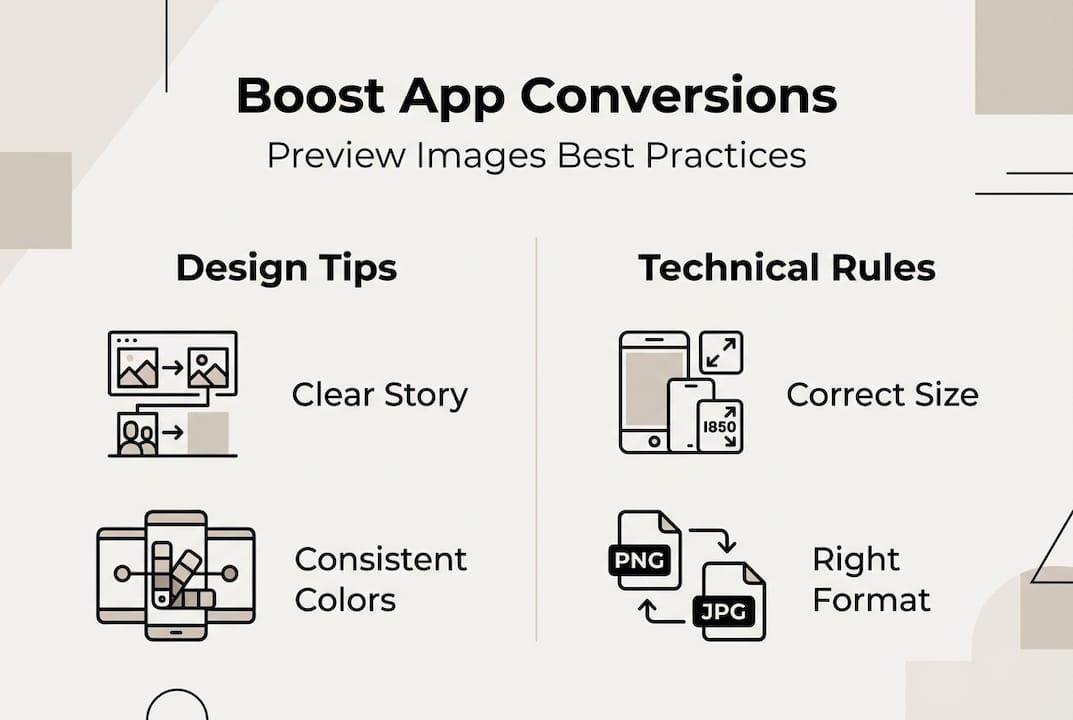
    Infographic showing app preview image best practices

    Your first screenshot is your headline. It needs to lead with your single strongest benefit, not a generic welcome screen or a logo. Users scanning search results see a thumbnail roughly the size of a postage stamp. If your text is small or your UI is cluttered, the message disappears entirely. Design for thumbnail readability first, then layer in detail for users who tap through to your full listing.

    Real UI overlays on device mockups outperform illustrated or abstract visuals. Users want to see what the app actually looks like before they commit to a download. Pair real screenshots with a short benefit caption in large, bold text. Keep captions to five words or fewer when possible.

    “Screenshots typically impact conversions more than app icons. Prioritize your first three to five screenshots, lead with your top benefit, and A/B test rigorously because small visual changes can produce outsized conversion lifts.”

    Common mistakes that cost developers installs:

    • Using the default simulator screenshot without any context or caption
    • Cramming too many features into a single image
    • Ignoring localization and using English text for all markets
    • Skipping A/B testing screenshots entirely and assuming the first version is optimal
    • Uploading images with alpha channels, which triggers automatic rejection on Apple

    Pro Tip: Treat your screenshot set like a visual story. Image one introduces the problem your app solves. Images two and three show the solution in action. Images four and five handle objections or highlight secondary features. This narrative structure keeps users engaged long enough to hit install.

    Quarterly updates matter more than most developers realize. App stores reward fresh listings with slightly better visibility, and user expectations shift over time. An asset set that converted well eighteen months ago may now look dated compared to newer competitors.

    Edge cases and advanced tips: maximizing impact with nuanced assets

    With the basics covered, let’s dig into the subtleties that separate good listings from great ones.

    Device-specific assets are non-negotiable if you support multiple form factors. iPad screenshots cannot be the same file as iPhone screenshots. Wear OS, Android TV, and tablet listings each require their own dedicated assets. Submitting phone screenshots for a tablet listing is a fast path to rejection and a poor user experience for anyone who does see your listing.

    Dark mode screenshots are increasingly important. A large share of users run their devices in dark mode full time. Showing only light mode screenshots signals that your app may not support the preference, which can quietly suppress installs among that segment.

    Localization is one of the highest-leverage moves available to small teams. Localized preview assets can boost installs by up to 48% in non-English markets. That is not a marginal gain. For an app with any international audience, translating your screenshot captions and adapting your visuals to local context is one of the best returns on time you can find.

    Advanced workflow tips for small teams:

    • Design all assets at the largest required resolution and scale down for smaller devices
    • Use device-specific mockups to maintain visual consistency across form factors
    • Include at least one dark mode screenshot per device type if your app supports it
    • Never include prices, discounts, or third-party brand marks in your screenshots
    • Avoid showing content that does not appear in the actual app, which is a direct violation of both Apple and Google policies

    Pro Tip: Set a calendar reminder every quarter to audit your preview images. Compare them against your top three competitors. If their assets look sharper or communicate value more clearly, that gap is costing you installs right now.

    One often-overlooked detail: videos autoplay muted in Google Play search results. This means your video must communicate its core message visually, without relying on audio or narration. Design your video as if the sound will never be heard, because for most viewers, it will not be.

    Take your app preview images to the next level

    Mastering the theory behind preview images is a strong start, but execution is where most small teams lose time. Manually resizing assets for every device, checking compliance with Apple and Google specs, and iterating on designs without a streamlined workflow can eat days out of a sprint.

    https://appscreenkit.com

    AppScreenKit is built specifically for this problem. You can create stunning screenshots using pre-built templates that already conform to Apple and Google size requirements, so rejection due to wrong dimensions or missing feature graphics becomes a thing of the past. The platform lets you place your real app UI into professional 3D device mockups, add branded text and gradient backgrounds, and export pixel-perfect assets for every device size with a single click. For teams juggling localization across multiple markets or managing assets for several apps at once, that kind of automation is not a luxury. It is a competitive advantage.

    Frequently asked questions

    What is the difference between app previews and screenshots?

    App previews on Apple are short videos showcasing app functionality, while screenshots are static images presenting the UI. Google groups both under the term preview assets, but the distinction still matters for upload slots and technical requirements.

    How can preview images improve app store conversion rates?

    Optimized images help users understand your app’s value in seconds. Screenshots impact conversions more than app icons, and combining strong design with A/B testing can produce significant lifts in install rates.

    What are common reasons for preview image rejection?

    Rejections most often happen because of wrong pixel dimensions, alpha channels in PNG files, inclusion of prices or third-party brand marks, or screenshots that show content not present in the actual app. Wrong sizes and alpha channels are the most frequent triggers.

    Should I localize my app preview images?

    Yes. Localization can boost installs by up to 48% in non-English markets, making it one of the highest-return investments available to small app teams targeting international users.

    Article generated by BabyLoveGrowth